








Service 01 · Private security
Security officers
Tailored protection for your sites.
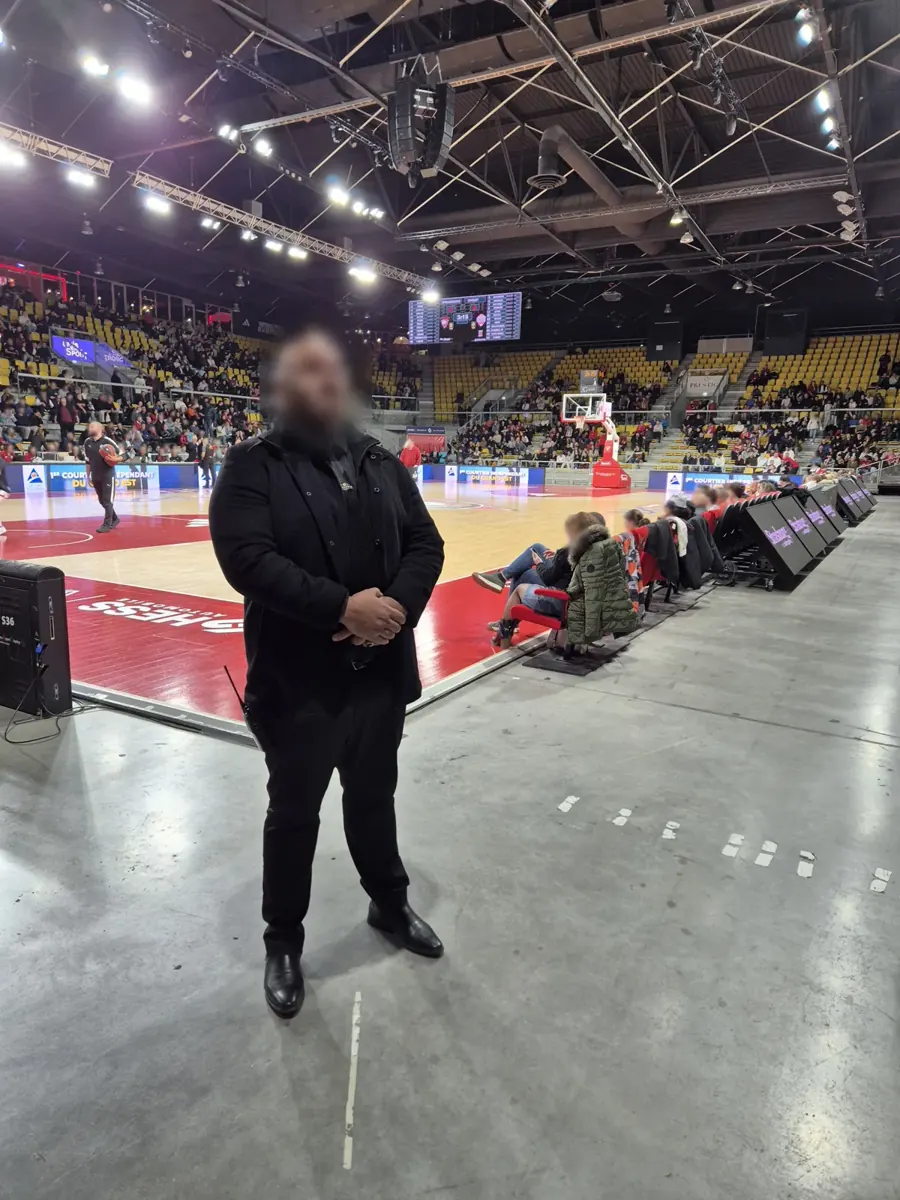
Officers licensed by the CNAPS (the French private security regulator), mobilised at short notice and under permanent operational supervision, keep sites safe and secure 24/7.
What we cover
Security officers: our scope of service
-
Deterrent presence
A visible, professional presence that prevents incidents before they happen.
-
Access control
Management of identities, people flows and entries and exits, under strict instructions agreed with you.
-
Rapid response
Immediate reaction and coordination with the police and emergency services whenever an alert is raised.
-
24/7 surveillance
Continuous cover, with reporting and a permanent on-call service.
A security officer is a professional holding a professional card issued by the CNAPS (the French private security regulator), posted on your site to prevent intrusions, theft and incidents, control access and respond when an alert is raised. Prestige Sécurité provides these officers to businesses, local authorities and premises open to the public in Strasbourg, the Bas-Rhin and the Grand Est, for a one-off shift as well as a continuous 24-hour presence, with its own officers, under permanent operational supervision.
Where is a security officer useful?
The security officer, often called a prevention and security officer, works wherever a qualified human presence provides what a camera or an alarm cannot: welcoming, screening, talking, deciding. The most frequent requests concern:
- offices and head offices, where visitors, contractors and delivery drivers have to be screened without slowing down business;
- industrial and logistics sites, with their lorry traffic, restricted-access areas and stock;
- local authority buildings and services that receive the public, sometimes exposed to antisocial behaviour;
- embassies, consulates and other diplomatic missions, where access control and visitor reception call for the discretion expected in diplomatic circles;
- premises open to the public, such as hotels or healthcare facilities, where reassuring people matters as much as protecting them;
- car parks and private grounds, often overlooked even though they concentrate a share of the risks.
If your site is mainly vulnerable when it is empty, at night or at weekends, manned guarding and its patrols will often be better suited. For a shop or an event, we offer dedicated services, with their own rules.
What does a security officer actually do?
The duties are set out in writing with you, in assignment instructions. They are built around four functions.
Deterring through presence
A visible, uniformed presence in a carefully chosen position: this is the first line of defence. Many offences are never committed because someone is watching. The officer greets people, gives information, moves around; they do not simply stand rooted in front of a door.
Controlling access
Checking badges and authorisations, keeping the visitors’ register, receiving contractors, checking vehicles coming in and going out, refusing entry to anyone who does not meet the conditions you have set. How this screening is organised is explained in our article on access control in the workplace (in French).
Responding to incidents
Verifying an alarm, intervening in response to suspicious behaviour, dealing with an aggressive visitor, alerting the emergency services or the police, receiving and guiding their teams when they arrive. The officer is often first on the scene: their composure and command of procedure count for more than their build.
Reporting
Patrols, observations and incidents are recorded in an occurrence log. Notable events give rise to a report sent to your contact. This traceability proves the service delivered and allows the security plan to be adjusted over time.
How is the service set up?
- The site visit. We come to see the premises, the access points, the sensitive areas and your hours, and we listen to what has already happened.
- Sizing. Number of posts, hours covered, any need for an additional qualification: we propose the right security plan, neither oversized nor cut-price.
- The assignment instructions. They are drafted with you: who comes in, through which entrance, at what times, who to inform and in what order in the event of an incident. This document is every officer’s reference.
- The rota. Shifts are organised to respect rest periods and anticipate replacements, so that the post is covered without interruption.
- Taking up the post. The officers dedicated to your site familiarise themselves with the premises and the instructions before staffing the post.
- Follow-up. A manager remains your contact, reviews things with you and adjusts the security plan. Outside office hours, the on-call service takes over 24/7.
What a security officer is allowed to do, and what they are forbidden to do
The profession is governed by Book VI of the French Internal Security Code (code de la sécurité intérieure), which regulates private security activities. Two authorisations are required together: the company must hold an authorisation to operate issued by the CNAPS (Conseil national des activités privées de sécurité) and each officer must hold a professional card in their own name, issued for the activity carried out and valid for five years. Renewing it requires refresher training to maintain and update skills. The details are set out in our article on the security officer’s professional card (in French).
The officer works inside buildings or within the boundaries of the premises in their charge. They wear a uniform that cannot be mistaken for that of the police and comply with the profession’s code of ethics.
They may:
- screen entries and refuse access in line with your instructions;
- carry out a visual inspection of bags and, with their owner’s consent, search them;
- in the case of a crime or offence punishable by imprisonment and caught in the act, apprehend the offender as any person may (Article 73 of the French Code of Criminal Procedure, code de procédure pénale), immediately informing the police so as to hand the person over without delay to a judicial police officer (officier de police judiciaire);
- act in self-defence, under its strict conditions.
They may not:
- check anyone’s identity;
- carry out a body search, or a security pat-down outside the cases provided for by law;
- detain a person other than when caught in the act;
- take the place of the police or the gendarmerie.
What affects the price of a security officer?
The rate is calculated by the hour. Several factors affect it:
- The hours covered. A weekday daytime presence and a post staffed 24/7 do not require the same number of officers: a continuous post requires a rotating team.
- Nights, Sundays and public holidays. These hours attract premiums set by the sector’s collective agreement.
- The qualification. A post combining security and fire safety (SSIAP) costs more than a simple surveillance presence.
- Duration and regularity. A recurring contract over several months allows more efficient organisation than an isolated shift.
- The number of posts and the constraints of the site: an isolated site, means of communication, procedures for a lone officer.
These mechanisms are explained in How much does a security officer cost? (in French). Always compare quotes on an identical scope, and be wary of a rate markedly lower than the others: it often hides a shortfall.
Why entrust your security officers to Prestige Sécurité?
- A Strasbourg company since 2016, based at 2 rue de Gribeauval and authorised by the CNAPS.
- More than 200 officers and zero subcontracting: the officers on your site are our own, recruited and supervised by us.
- More than 3 700 interventions a year and 200 000 m² of sites protected.
- A 24/7 on-call service, reachable on 03 88 31 59 50.
- A Banque de France rating of G3, a marker of financial soundness that matters for a long-term commitment.
- A Google rating of 4,1/5.
To compare several providers with confidence, use our guide How do you choose a security company? (in French), then tell us about your site: the proposal is free and with no obligation.
Frequently asked questions
Can you send a security officer in an emergency?
Yes, our on-call service can be reached 24/7 on 03 88 31 59 50 to assess an urgent requirement: a break-in, a site left vulnerable by damage, the unexpected absence of your own staff, a reported threat. How quickly officers can be in place depends on the location, the time of day, the qualification required and the officers available at that moment. We will tell you frankly on the phone rather than promise a time we could not keep. To save time, have a few details ready: the exact address and access arrangements, the nature of the risk, the expected duration, a contact who can be reached on site and the essential instructions. An assignment started in an emergency is then formalised in writing, with full assignment instructions, and can develop into a long-term security plan if the need is confirmed after a few days.
How many officers does it take to staff a post 24/7?
A post staffed 24/7 always relies on several officers taking turns, never on just one. A week has 168 hours, whereas the statutory working week is 35 hours, and rest periods, holidays and absences also have to be covered. The post you see on the ground is therefore backed by a rotating team, organised through a rota that complies with the collective agreement for the private security sector (convention collective des entreprises de prévention et de sécurité). The exact number depends on the actual hours to be covered, the length of the shifts chosen and any periods of reinforcement. A stable team has another advantage: the same officers know your premises, your instructions and your contacts, which reduces errors at every handover. This is a point to examine in any quote: how many officers will be assigned to your site, and how replacements are organised.
Can a security officer demand ID at the entrance?
No: they can ask for proof of identity as a condition of entry, but they can neither demand it nor carry out an identity check, which is reserved for authorised bodies such as the police and the gendarmerie. A private security officer has no police powers. On a business site, they apply the access rules you have set: showing a badge, signing the visitors’ register, checking that a visitor is actually expected. If the person refuses, they are not compelled: they are simply refused entry and the officer informs your contact on site. Data collected in a visitors’ register must also comply with the GDPR: collect only what is useful, inform the people concerned and set a retention period. These rules are best written into the assignment instructions, so that every officer, regular or relief, applies them in the same way.
Can a security officer watch the street outside my site?
In principle, no: a security officer works inside buildings or within the boundaries of the premises in their charge, as laid down by the French Internal Security Code (code de la sécurité intérieure). Your car park, your yard or your private grounds fall within their remit; the public highway does not. Exceptionally, the prefect may issue an order authorising surveillance on the public highway, including mobile patrols, against theft, damage, break-ins and acts of terrorism targeting the property in the officer’s charge, without going beyond its immediate surroundings. This authorisation is not automatic and must be applied for case by case. In practice, if the officer notices something suspicious in the street, they observe, take notes and alert the police, without exercising any powers there. If your site has sensitive surroundings, we discuss this during the site visit to define clearly what falls to private security and what falls to the authorities.
Can the same officer handle both security and fire safety?
Yes, provided they hold both qualifications and the two roles are clearly organised. Protection against malicious acts (access, intrusion, theft) requires a professional card issued by the CNAPS. Fire safety in premises open to the public and high-rise buildings falls under different regulations, which require an up-to-date SSIAP qualification. An SSIAP officer who also carries out security tasks must therefore hold the professional card, and a security officer cannot staff a regulatory fire safety post without SSIAP. Finally, combining the two must remain compatible with the fire safety obligations specific to your premises, which depend on their type and category. We check this with you before proposing a combined post, and we divide the tasks in the instructions so that fire safety never takes second place.
Your request
A quote for security officers
Tell us what you need: a tailored proposal within 24 working hours. Free and with no obligation.
Your request has been received.
Urgent? On call 24/7 — 03 88 31 59 50.
Our other services
A complete security force
Verified Google reviews
What our clients say
Assignments delivered, and clients who say so: the reviews published on our Google listing.
-
★★★★★
Retour juste après le tournoi de l’équipe de france de handball au Rhenus de Strasbourg. Top top top! Les agents étaient courtois souriant et sympathique en plus d’être professionnels et rassurants.
ClaireGoogle review
-
★★★★★
Entreprise professionnel et conviviale, qui maitrise parfaitement son domaine.
Tom D.Google review
-
★★★★★
Je conseil très fortement, équipe très réactive, service commercial très agréable. La mise à disposition des agents et confirmer rapidement et leur profil est toujours adapté. J’en ai eu besoin pour un événement scolaire et leur réponse a été plus que qualitative. Pour un besoin en sécurité, je n’irai sans aucun doute nulle part ailleurs.
Rabia S.Google review
-
★★★★★
Prestation parfaite de A à Z!!!
Gregory M.Google review
-
★★★★★
Sérieux, calme, pro. Entreprise de sécurité irréprochable. Je recommande fortement
Hamid E.Google review
-
★★★★★
Entreprise très sérieux, Je recommande et très professionnel Agent de sécurité très agréable et professionnel
Samir F.Google review
-
★★★★★
Meilleur boîte de sécurité bravo
NassimGoogle review
-
★★★★★
Merci pour votre professionnalisme au stade cette après midi et surtout à l’agent qui m’a accompagné pour sa bienveillance étant en situation de handicape
Hassna B.Google review
-
★★★★★
Meilleure entreprise de sécurité de la France toujours de bon travail
Khalifa A.Google review
-
★★★★★
Les agents de sécurité présents au stade cet après midi ont été d’un grand professionnalisme. Ils ont su assurer la sécurité dans la tribune tout en faisant preuve de bienveillance envers les spectateurs (enfants perdus, personnes à mobilité réduite, personnes âgées...). Vraiment très appréciable merci !
Anna S.Google review
-
★★★★★
Accueil très sympa et professionnel
Patrick C.Google review
-
★★★★★
Excellent service et à l’écoute! Merci à vous encore
Sam J.Google review
-
★★★★★
Entreprise, disponible et compétente
RourouletteGoogle review
-
★★★★★
Prestige Sécurité est une société très professionnelle autant par son encadrement que par l’ensemble de ses agents.
niicckoGoogle review
-
★★★★★
Un nouveau visage de la sécurité est enfin représenter à Strasbourg . Tester c’est l’adopter ! Je conseille Prestige Sécurité aux futures agents de sécurité et aux prestataires .
Hicham F.Google review
Our territory
Strasbourg, the Bas-Rhin & the whole Grand Est
From Strasbourg to Reims, from Metz to Mulhouse: the whole Grand Est. On the German side (Kehl, Offenburg), assignments are assessed case by case.
A permanent on-call service, controlled response times.
2 rue de Gribeauval · 67100 Strasbourg
- Strasbourg
- Illkirch-Graffenstaden
- Vendenheim
- Wolfisheim
- Oberhausbergen
- Molsheim
- Brumath
- Thionville
- Troyes
- Offenbourg
- Schiltigheim
- Ostwald
- Mundolsheim
- La Wantzenau
- Haguenau
- Obernai
- Colmar
- Nancy
- Châlons-en-Champagne
- Bischheim
- Lingolsheim
- Souffelweyersheim
- Geispolsheim
- Sélestat
- Erstein
- Mulhouse
- Épinal
- Kehl
- Hœnheim
- Lampertheim
- Eckbolsheim
- Fegersheim
- Saverne
- Bischwiller
- Metz
- Reims
- Ortenau